Security
Authentication
Any uses a cryptographic password hashing technique to secure the storage of the passwords. The credentials of the users are hashed before being saved in the data storage system. Hashing the credentials is one of the most common security techniques when protecting the private credentials of a user. The hashing algorithm used is SHA-512. A random salt is added to the hashing process to force their uniqueness, increase their complexity without increasing the requirements on the users and mitigate password attacks like "Rainbow tables".
To limit brute-force attacks on the password, you can configure a maximum number of failed sign-in attempts. Beyond this limit, the account is blocked and an email is sent to the administrator.
Authentication can also be configured on an external system with SAML, Kerberos and others.
Service security
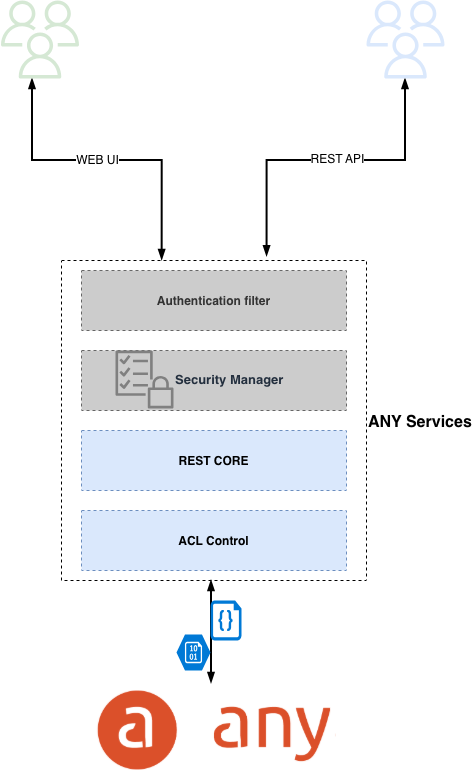
Security is applied in the Any Webapp and intercepts every request. When a service is called, the Security Manager intercepts the request and checks that the user has sufficient permissions to reach the service. The first layer filters the action based on the authentication and the roles of the user. The security of the documents is based on their contexts. A user can have a write permission from an application and read-only from another. Any has 2 types of permissions:
- Listing permissions, which let a user search documents and view their metadata.
- Advanced permissions, which let the user see the content and run an action on the documents.
This separation keeps the search performant and gives a strong, fine granularity for the other permissions. A pre-check is done to avoid displaying the action on a content if the user does not have the correct access. Both types of permissions are constantly checked for every action.
Communication encryption
The high-availability environment requires several nodes for MongoDB and Elasticsearch. You must use the TLS/SSL protocol (Transport Layer Security) to secure the communication between the nodes and for every incoming and outgoing connection.
Each layer has its own communication encryption mechanism. You must refer to the MongoDB and Elasticsearch documentation to encrypt the communications.
Once the communications between each node are secured, you can encrypt the client communications of MongoDB and Elasticsearch. The communication between the Tomcat server and the client can also be configured with TLS/SSL encryption.
Encryption at rest
Any uses the native encryption capacity of your file system. If your environment requires data encrypted at rest, you must use an encrypted file system partition.